
Samuel_Tow
-
Posts
14730 -
Joined
-
And so the endless battle to prevent people from pre-purchasing new powers without having played through new content continues. I'm just glad I'm not invested in the system for a whole host of other reasons, but for the people who are - you have my genuine sympathies.
-
I remember that post

Honestly, I would like to see all three to the point where I'm really not sure what I'd choose. If I HAD to choose, I'd choose for the one that makes Assassin's Strike less situational in general use, but still situational if you want the Assassination Critical, so I guess my call would still go for Idea 2.
Speaking of idea 3, actually, I have sort of a counter-suggestion on the subject. If the system really does support out-and-out swapping powers depending on a "mode" flag, then this presents us with the opportunity to reimagine Assassin's Strike altogether, into what I'd like to call a "speciality" attack. Let me explain.
A Stalker's Speciality attack, rather than all being close of the same Assassin's Strike, is actually unique to the Stalker's primary set such that it complements the set and balances what the set doesn't have, both in and out of Hide. For instance, if you're playing a Martial Arts Stalker, you have NO AoE whatsoever, so this Stalker's Speciality Attack out of hide would be a decent AoE, while in hide, it would be more or less the same as the existing Assassin's Strike, only with a Mag 4 relatively long stun on top of the Demoralisation effect. If, by contrast, you're running an Electric Melee Stalker, then your Speciality attack out of Hide would be a heavy single-target attack, while from hide it would be an Assassin's Strike with a SEVERE endurance drain and recovery suppression attached to it.
One of the big problems with giving AoE to Stalkers is that not all Stalkers need it. The ones who need it, need it bad. The ones who don't may actually be broken by it. If we are able to tailor the Speciality attack such that out of hide it compensates for the set's weakness while from hide it capitalises on its strength, that might be one HUGE step in the right direction.
---
As a side note, many of those suggestions have an implicit pre-requisite: That Assassin's Strike, at least out of hide, be made uninterruptible. Right now, the power is thrice-cursed. It's interruptible so you can't use it in battle, most of its damage is restricted to its Assassination Critical from hide, and even when you do manage to use it in a scrap, it's too slow to be of any real use. Making the out-of-hide Assassin's Strike worth a crap would actually go a long way towards making Assassin's Strike as a whole feel like less of a gimmick, and it would actually go a long way towards limiting complaints about the power's "from hide" performance.
Thanks for posting this, Leo. I feel that if this is acted upon in line with any of your three ideas, this might be as big for Stalkers as the ye olde Stalker fixes. -
Quote:I apologise if this comes off as me being a spoilsport, but... Nothing. Nothing can ever inspire me to copy or recreate other people's work. Even if I draw inspiration from an existing intellectual property, I'll go out of my way wrap that up into a character who's solely and truly my own and that others haven't made before. I think the closest I have is my Jun, who would look like Street Fighter's Sakura, if Street Fighter's Sakura didn't look like every Japanese Schoolgirl ever, but I still went out of my way to build an entire character around that concept which essentially hides the resemblance.Originally Posted by Thirty-Seven
 What inspires you to make a character that is inspired by an existing intellectual property?
I don't mean to speak against people who do this, of course. But as I said in another thread, my brain just doesn't work right unless I am able to create characters other people haven't thought of before. Recreating other people's work just has no value to me because... Honestly, the original authors did it better. -
I pay because I like having live Customer Support.
-
Quote:But it also diminishes the scope of the accomplishment. I like to feel like I've come up with something that's unique because other people haven't thought of it, as opposed to because other people are over it by now. Mind you, I'm not complaining, but my brain just requires something like that to work rightOriginally Posted by Megajoule
As for your question, I think it might help to wait a few months, until you're not One More Jarhead in a sea of them. That tends to make anyone feel a little less "unique".
-
Quote:This is the way of the newer writing, and while not bad on its face... I'm still not sure I like it. Let me explain.Originally Posted by Warkupo
First Ward, and Going Rogue in general, actually feels like it has a 'cast' of characters with their own personalities, plots, and relevance. I'm actually going to *remember* the characters in First Ward and the crap we went through together. There's villains who I actually have a reason to dislike beyond them just being evil, and angry, and in my mission so I have to kill them. A re-occuring cast is definitely a good thing, and something I wish the rest of the game utilized more often.
In the old game, almost no characters were ever persistent. Bosses showed up to be beaten and never heard from again, contacts had interchangeable models and backstories (literally interchangeable) and very few people even had a role in more than one mission. Yes, those are all bad things and I fully admit they were problems. But at the same time, the game's actual PLOT was always consistent pretty much the entire time through. For instance, in the 35-40 range, all of your contacts are wondering about this modern cult that Baron Zoria founded a hundred years ago called the Circle of Thorns, yet in the 40-45 range, everyone already knows that they are the ancient Oranbegans.
It's basic concepts like that which get introduced and remain persistent throughout the game. The Might for Right is mentioned in the earlier Sky Raider arcs, I believe, and becomes relevant once more with Malta in the 40s, just for example. In a 30-35 mission, you release Executable 6 onto the Internet where it can live happily ever after. In a 35-40 arc you're assisted by "the Doctor," a ghost-in-the-machine hacker against Crey. In a 40-45 mission, a contact mentions being helped by the Doctor and Executable 6. The game's entire world is living, active and changing behind the scenes, and if we pay attention to the little tidbits we see of it through our adventure, we can put together the bigger picture.
That's... Not quite the same in First Ward, because there really isn't much of a "story" to the zone. The entire place is a snapshot of events. To give credit where credit is due, the disaster among the Test in the Free Fire Zone is a good plot point which remains consistent, but even then - the world does not change unless you, personally, go out of your way to change it. Nothing happens off-screen, no-one does anything unless you start a mission to do it. Even Circe the Sorceress shows up exactly as you're heading out to confront Diabolique.
The original game was written to be HUGE, and it was written to evolve on its own even without the player's input. Sure, players were allowed to participate in much of that progression, but events you didn't have the opportunity to participate in (say you outlevelled the story arc) still happened, it was just someone else who did them. In fact, to this day City of Heroes has a metric ton of "story seeds" that were never explored, or never explored well. Tub Chi, Dreck, Lughebu, Blood of the Black Stream, the Warriors, the Family, the Luddites, Bat'Zul, the Red Hands, the Scrapyarders and more. By contrast, Praetoria seems to have been written with exactly as much backstory as is strictly necessary to carry a player through the storyline with very little background "trivia" beyond that.
First Ward is probably the worst offender in this case. First Ward IS the storyline given. Anything ever brought up gets hooked into a storyline somewhere and everything ever brought up is a major plot point. It's all exposition and very little atmosphere, is what I mean. And while the First Ward visuals and sound do help set up the mood, and they do a damn good job of it, too, there just isn't much the story can contribute.
Let me put it this way - do you remember ye olde aD&D adventure games? You could walk into a town and speak with nearly everybody, and they were all too eager to tell you about the politics of the region, current social issues, their religious beliefs, rumours about their neighbours, their local officials and even about the absolute rulers and even occasionally just jabber about the weather. Little of this was ever directly useful for a specific quest, but having the ability to speak with these people forged a much more "visceral" world that I "got" even if I didn't know everything about it or I couldn't necessarily describe it.
First Ward has very little of that, save for Cheshire talking about the Gumbo. In fact, go back to the old pre-I1 game and check contact descriptions: Sure, the contacts are interchangeable, but all of them have their lives put down to print. Someone sat down and gave these guys an actual history. Most of the newest contacts seem to just have a couple of sentences to tell us who they are, but rarely where they came from. And I miss that. -
Quote:You're inventing logic where such doesn't exist. NOT being given something is not punishment. You act as though you're going to keep running these Trials, not getting these rewards and then complain you are being punished. If you already know about the rules, then pick your tasks accordingly.Originally Posted by Giant2005
After the patch, just like a fine for a traffic violation or whatever, the currency I would normally be earning is being taken from me before I get access to it.
-
Quote:I miss Lighthouse. His methods may have left a few people burned, but he got results like I haven't seen before or since.Originally Posted by reiella
I do agree that the flash incidents have been worse [I'd include AE/ban threat and PVP/Lighthouse with those as well]. However, those are singular events as opposed to a climate of hostility. While they do tend to leave a residue [and be more memorable], I don't really consider them indicative of the toxicity.
-
When I find myself burning out, I look for inspiration, either in the form of new characters to create or old characters to reimagine. The Best Costume Designs thread is a great source of these, but it's hardly the only one. Other games, books, movies and even real life provide plenty of opportunities to find inspiration. Maybe you saw a fictional character you really liked and wanted to transfer to City of Heroes or maybe you saw a documentary about a person whose story could make for a great hero with a judicious application of embellishment and outright fabrication?
I've also found that new ideas work best when you run them by other people first, though this requires someone who's either creatively- or logically-minded and has the patience to discuss these things. If such people are absent from your circle of acquaintances, the Costume Redesign thread is great for this (and, yes, I realise the last page is spammed with my own stuff). The thing is that ideas often sound great in our heads and even look good when put to character... Until we sleep on them and wonder what the HELL we were thinking when creating Insane Rick. Getting someone else's perspective helps weed out the bad plots and also helps flesh out the good ones.
I'm not sure that you can stay for years and years if you rely on JUST the base game to deliver fun for you. It's not that entertaining once you've done most of it. For me, the greatest joy in this game comes not JUST from playing it, but from playing it with an amazing character that turns heads (even if it's for the wrong reasons). City of Heroes is, at the end of the day, a fantasy. It's an action figure come to life, and an action figure of your own making. Maybe I never grew out of the mental age of five, but I can't think of anything more I want out of life
-
I'm not sure if that's genuine surprise or sarcasm, but thank you, Arcana. That made me smile
And while I've not yet started work on my jarbrain vampire (as I've already made more than enough new characters), I will definitely move forward with it when time permits. I really love that idea, absurd as it may be. -
Quote:You can't get close enough. There's an instance boundary wall in the way.Originally Posted by Zombieluvr
I didn't get close enough to see if Hami was a legitimate threat (I assume not), or just window dressing.
-
Quote:I said many of the same thing back in I19 Beta and, hell, even in I18 Beta, and aside from the questions of personal preference, the one argument that kept recurring was that this is a better way to condition players to keep playing at full motivation. Someone brought up a study suggesting that if players could track their own progress, their activity followed a pattern of highs and lows. When players were near their goal, they played more intensely in anticipation of that goal, but when they got it and observed the long road to the next goal, their intensity diminished as they knew that no matter what they did, the goal would still be very far away.Originally Posted by Feycat
My biggest problem with the incarnate trials is that it doesn't *feel* like we're "advancing our characters past 50." It feels like we're grinding for loot - which we are. But putting all the rewards at the very end, and having no visual indicator that we're advancing is taking all the psychological 'training' the game's given us for the last 50 levels and tossing it out the window.
I would really *like* to see an ixp bar for the relevant slots when I zone into a trial. I would really *like* to see the level-up (ding!) graphic when we unlock a slot. I would really like to see occasional drops of common/uncommon i-salvage while you kill things in a trial (which would have the bonus of helping to encourage actual clearing rather than just zerging the objective.)
I think those things would really help me feel like I'm actually advancing my character, even if it doesn't change all that much. Otherwise, I feel like I'm just at the market trying to slap together one last IO for my set and waiting for my bids to fill :P
The solution to this - that is to say, the way to make players play at a high capacity at all times - is to mask the proximity of the goal. When a player believes that THE VERY NEXT KILL could land him his goal, he will play more intensely. Of course, no-one expects to get the right drop right away, but we all hope that if we're looking at a 1 in 20 shot, we would still get it on something like the fifth time, as opposed to all the way on the 20th, or even on the 40th as isn't out of the question. Though player activity never reaches the fever pitch of "the last bar," it also never slows down like it does after the level is reached.
This, hiding player progression and trying to trick players into anticipating progression without actually giving it to them (because there's precious little to give) becomes the frankly exploitative approach to stretching little content over a long time.
Once upon a time, I suggested that Incarnate salvage drop rates be increased a hundredfold and costs increased a hundredfold to compensate, leading to roughly the same amount of effort and time commitment, but with a much greater feedback of progression and a much better understanding of where we stand on the path to the goal. This was turned down because, according to some, it just turned the whole system into a giant grind instead of what I presume was intended to a gambler's high game. Somehow, the system ended up being a giant grind despite this, it's just a grind that has zero motivation to move me along. -
Quote:This reminds me of that old "dystopian future" commercial from I think one of the RoboCop movies. In that movie, the ozone layer is nearly gone so sitting out in the sun is deadly, but the rich corporations are marketing a "factor 9000" sunscreen lotion that is effectively like covering your body in blue tooth paste.Originally Posted by Bounder
I guess that is one way to get around the "can't be in sunlight" restriction, heh.
The reason I bring this up is it gives me an idea - what if the brain is all that's left of the vampire and it's being suspended in a solution that's not meant to sustain it, but rather to protect it from the sun, shield it from holy water and ward against crosses and such? I mean, you can still theoretically break the bowl, but that's not as easy when it's an inch thick and made of bullet resistant reinforced glass, and spherical, to boot
OK, this idea is getting better and better. -
Quote:Welcome to last year, MOO. We missed youOriginally Posted by AmazingMOO
The very basic root of the problem is that the Incarnate System, as it's working right now, is not very FUN.
Incarnate Trials are not fun. They were never fun. Moreover, they were never designed to be fun. They were designed to be a player-conditioning Skinner box. They were designed to be addictive. They were designed to the most repugnant practices in game development, where the goal isn't to entertain players but rather to keep them locked on a constant treadmill by engineering the experience such that it constantly gives players cues to try harder and grind more and never gives them any stopping points.
Incarnates are farming for merits. The system isn't designed to keep you entertained, they're designed to keep you subscribed. There simply isn't time in the day or cash in the kitty to do anything other than a grind - a very long, very difficult, very repetitive bit of content that you're supposed to never be able to truly play through. For all the bad things we've said about Jack Emmert, at least the guy had the balls to admit that MMO raiding in the classical sense is garbage and that trying to put it into City of Heroes would be too expensive and not very fun.
Funny thing is that the exact arguments the development team in general made against "end game" back in 2004 and 2005 are the same reasons people get turned off the Incarnate system for. These same arguments are why I never felt that this was necessary, and will never agree it was a good idea until it finds a way to be more entertaining than it is psychologically addicting.
I vote for all of the above. Huge-team ordeals are just a gigantic mess that doesn't appeal to nearly as many people as "raiding" would have you believe. Effectively hiding post-50 progression behind it is what's causing so many people to cry foul when anything is slowed down - because few actually want to do this, while most are in it for the rewards.Quote:Originally Posted by AmazingMOO
Confusing goals aren't fun.
Being Insta-killed isn't Fun
Zerging an Objective isn't fun.
Sitting in the Hospital while other people finish the challenge isn't fun.
Grinding for Currency to Buy Rewards isn't Fun. (It's called 'Work' in the Real World.)
Downtime is no fun.
Trying to Corral 16 or 24 Strangers is not fun.
I don't discount the merit of having cluster-hug tasks in the game. I just discount the view which sees them as "better" than small teams or even solo and sees them as the next, better step in the game's gameplay. What this does is create a wholly different type of game for a whole portion of it.
In my opinion, the "end game" should never have been just raids, and raids should not have been restricted to it. Raids should have existed all throughout the level range, and SOMETHING ELSE should have existed in addition to them in the end. City of Heroes is one of the few games where you get to tailor your own gaming experience, and it doesn't make sense to me that this only applies up to level 50.
However, I have to call you out on this:
"Rewards" is a misnomer for game progression. A large part of the fun in City of Heroes comes from starting out underpowered and having more and more power become available through the course of the game. That sort of character progression is the cornerstone of every RPG and a lot of non-RPG games, as well. It's only when the game starts being treated as "word vs. reward" that this is problematic.Quote:Originally Posted by AmazingMOO
I suppose a good way to look at it is to ask yourself, if City of Heroes were a sandbox game and the rewards were removed completely, would people still play simply for the sake of playing?
If City of Heroes had no rewards, it would have no progression, and if it had no progression I wouldn't play it. There's nothing to be gained by making a level 50 character and just spinning your wheels at the level cap. The rise through the levels is most of the fun, and this requires a progression system built of tasks to perform and progression to earn from them. That's how these games are built. "If there were no rewards" is a trick question when directed at an RPG, because most RPGs' gameplay is centred around character progression, be that through levels, achievements or gear. You can't get that out of the game and have it be fun any more so than you can take the guns out of a shooter and still have it be fun. You can probably pill off a miracle and make one or two games that worked that way, but by and large, those are just part of the game.
What you need to ask is when the game itself stops being the draw and becomes the obstacle. -
Well, to break with tradition, I'm really not that upset with my inability to log into Beta. I honestly don't give a rat's *** about anything Incarnate (apologies to the system's fans) and I'll buy Titan Weapons regardless of what it actually is, so even if I don't get to test, that won't change the future.
Of course, if I don't get to test Titan Weapons ahead of time, then I'll have to keep telling people why I didn't ask for these extra weapon models in Beta or why I didn't point out those bugs in Beta, but that's really no bother at all
-
Quote:I could log in yesterday, but I can't log in today. Apparently the CoH Beta VIP server is restricted to me. Well, that's the extent of my testing, then.Originally Posted by Lord_Kalistoh
Some of us can't log in the VIP Test because someone didn't switch back our accounts to VIP status in Beta Servers.
-
Quote:Well... OK. That's part of how the system works, and I'm sure that particular implication has been considered.Originally Posted by SwellGuy
If I read it right he is saying he is cancelling his sub and moving from VIP to Premium and implying the majority will follow him. I could be wrong but that's how I read it.
That and the Architect, which last I heard wasn't in any of the veteran rewards or in the Paragon Market. Not that I specifically WANT the Market, mind you, and I already have T9 VIP status, so that's not an issue in my case. But I'd lose access to the SSAs and I'd lose Time Manipulation, at the very least. Plus, I like having live Customer SupportQuote:Originally Posted by Lazarillo
Depends how far along in the tiers you are. I could cancel and keep pretty much everything. The only thing in my case that I'd definitely and permanently lose access to is this mysterious "Incarnate System" people keep talking about.
-
Quote:Not gives us an opaque Think Tank. Damn it!Originally Posted by Johnny_Butane
None of that fixes Tankers, however.
-
Quote:Well, everything minus Inventions, First Ward, side changing, the Architect, Time Control and a bunch of other things I have to buy, plus Celestial Armour from VIP vet rewards. I see what you mean, though. I get the thread, I supposeOriginally Posted by The_Spad_EU
I believe the argument is "OMG Incarnates are ruined for EVAR!!!" so why bother paying for VIP when you can get everything except incarnates as a premium player.
-
I'm not sure if this qualifies as a story, but I've been working for a bit of a weird concept of late, and I managed to finalise two somewhat weird characters at long last, and I kind of wanted to share. I apologise for flooding the forums with so many "look at me!" posts and threads, but I promise this will be the last one for some time. Their story is a... Long story, but they cost me quite a few sleepless nights all told. I've been burning out of late, and with "nothing interesting" coming any time soon, I needed a fresh new idea.
Enter Stardiver and Lighteater, my "ancient creations!" Sentient automatons made at the beginning of time by one of the universe's original creators researching the phenomenon of life, these machines resemble a humanoid shape, but are comprised of technology and science so abstract that only a creature of omnipotent knowledge of the building blocks of reality could conceive. Unlike human machines based around complex constructs of moving parts interlocking with each other inside an empty shell or even alien technology based around engineered organic life bound to mechanical devices, Stardiver and Lighteater are an amalgam of transcended material science and precise knowledge of exotic high-energy dynamics. With their physical shells comprised of dense, sold mixtures of incomprehensible chemical compounds mixed and separated in bizarre ways, they more resemble living, animate statues given life and sentience by cosmic forces.
The purpose of these eldritch automatons is shrouded in mystery and lost to the ages, gone from the complex minds of even the machines themselves. It is believed their creator made them as research tools in his quest for understanding the concept of life and determining whether there really existed a higher spirit, or whether life was simply restricted by the physical operation of a living creature. The automatons were built, used and then discarded. Too resilient to destroy even by their own creator, they were cast away into space, left to their own fate as the unneeded tools they had become. Driven by the basic urge to survive, Stardiver and Lighteater preserved their own existence by subsisting on the cosmic energies they had been built to harness and exploiting the duability that their bodies had been made with. These weird, mute, powerful aliens were seen as invaders and outsides on the worlds they visited, eventually teaching them to shun inhabited worlds when they could to avoid the physical damage of combat with the locals, as well as the psychological pain of being reviled.
That is, until they came to Earth. This is where the stories of Stardiver and Lighteater diverge.
This is Stardiver:
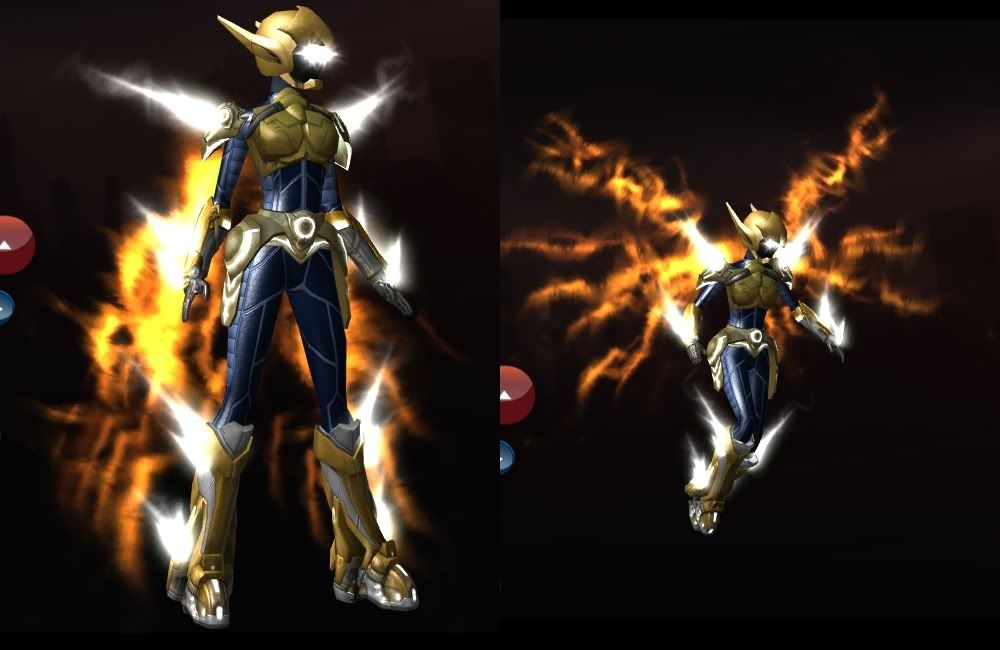
Stardiver was the original automaton, first created as the "test bed for life." To survive the many millennia of testing, her body was built to be practically indestructible, and to provide her with sufficient energy to function for this duration and operate on the cosmic level of her Creator, Stardiver was designed to - as her name suggests - dive into the hearts of living stars and expose herself to the hideously hostile environment therein. The link between basic matter and the various chemical substance that make up much of the universe, the hearts of stars were the ideal location for Stardiver to craft the materials she needed both construct and reconstruct her own body, should it become damaged. The enormous heat and pressure there permitted the creation of materials that modern science can still not accurately describe. As well, Stardiver's body was equipped with a large, dense, solid heat sink, and indeed entirely adapted to store pure heat energy, which she then used to fuel her existence. A dive into the heart of a star could heat Stardiver's body to enormous temperatures, infusing it with enough energy to run it for an incredibly long amount of time - vital for a creature built with no means of producing its own energy.
When Stardiver dives into a star, she emerges overheated beyond capacity, her abilities weakened and her control of energy suppressed. She must, therefore, find a means for venting that heat from her body. With the vacuum of space being such a poor conductor, Stardiver's regular practice is usually to find a nearby planet on which to reside, convecting her heat into its atmosphere or lithosphere, speeding up the process considerably. It is this need of hers which brought her to our Earth after diving into our own sun. Finding the planet inhabited was a surprise to Stardiver, but the people of Earth proved to have much more tolerance for "weirdness" than any species she had met before, with some even actually attracted to her specifically BECAUSE she was so alien and unusual. Not being met with the hostility she had expected and feeling strangely drawn to the emotional interaction humans offered, Stardiver chose to remain on Earth for the rest of her cooling-off process, minding to restrict her thermal vents down to levels which would not damage the planet's living creatures.
Engaged with other creatures for the first time in her existence, Stardiver's personality began to unlock and her mind began to mature. For the first time, she began to wonder what her purpose in existence was. For the first time, she began to see other life a kindred spirits, as opposed to a nuisance. But also for the first time, Stardiver learned to appreciate life's fragility. She had no concept of death, as she couldn't truly die, but when people she had developed an attachment to did die in an irreversible way, she felt pain. For the first time in her existence, Stardiver had a reason to live. She saw herself in the humans she protected, for they too were made without purpose and cast into a hostile world to survive and carve their own path. And in the happiness they found, Stardiver found her own purpose - to protect these people and their happiness, and perhaps one day even join into it.
To this day, the "weird little alien" is still something of a social outcast. She doesn't speak - she can't - and keeps her distance from most people. After having spent an eternity alone with nothing but her own thoughts, she is never quick to open up to strangers, and will happily ignore the advances those she hasn't chosen to bond with. She will protect their lives, of course, but much in the same way an errant storm will protect the shores of a bedraggled nation from an invading fleet - as an incidental gesture and nothing more. It is only her small circle of real friends that she will seek to interact with, and with their help, protect the lives of the innocent and the unaware as best she can. And as her body cools down from the heat of the sun, her true power is slowly revealed.
By contrast, this is Lighteater:
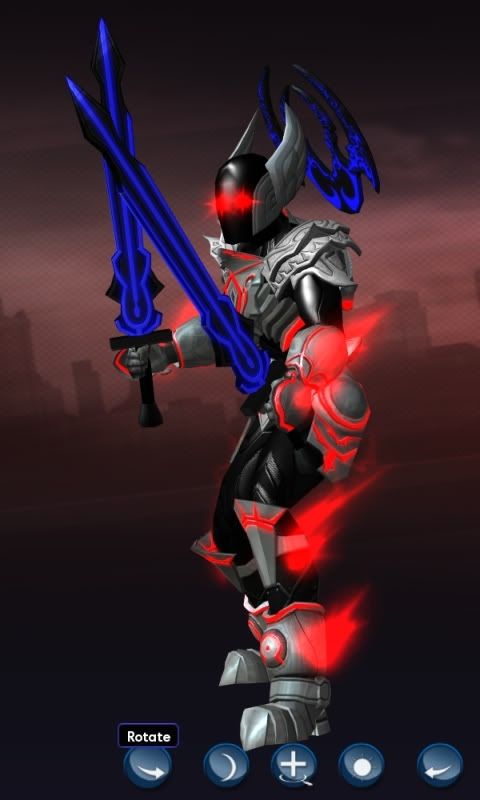
The second, last, and reputedly greatest creation of their original Creator before the great cataclysm which ended his existence, Lighteater was meant to succeed Stardiver after she no longer had a use to her creator. Though Lighteater's body was similar, his design was far more ambitious, as he was intended to dive into the cores of black holes. Designed with a small, super-dense dark matter core, Lighteater houses a genuine gravitational singularity within his own body. A complex alloy of unknown metals provides powerful gravitational shielding to contain the singularity's energy field within his own body while the super-massive dark matter core at the centre of the singularity serves to keep it from collapsing and channel its energy outwards to both animate Lighteater's body and manifest as raw energy outside his body. This grants him the power to fold space transition between any two points quite literally instantly, as well as the seemingly impossible ability to leave the interior of a black hole cross back out past its event horizon. As the dark matter core expands over many aeons, Lighteater's internal singularity loses power until the material is so disperesed that it produces such a small gravitational force that cannot be felt past his internal shielding, forcing Lighteater to see another black hole with which to re-condense his singularity and return his energy to usable levels.
The complex physics involved with the solid dynamic of materials which make up Lighteater's body causes his energy levels to weaken for a long time after he has emerged from the core of a black hole, forcing him to wait until his singularity stabilises into a usable form. Unlike Stardiver, this is best accomplished within the vacuum of space away from both the natural gravitational fields or normal matter and the disrupting effects of dark matter. Though Lighteater normally preferred to avoid planets entirely, and inhabited planets altogether, it was Stardiver which drew him to Earth. Sensing her erratic energy patterns, caused by her forcibly regulating the venting of her heat, Lighteater found himself curious for the first time. The one constant in his cognition had changed, so he felt compelled to investigate. Finding himself on Earth where his unusual appearance and powers were not just tolerated but even embraced, however, was a novel experience for the automaton. Like Stardiver, his emotions were forced to awaken in an effort to deal with the unfamiliar, irrational environment, but Lighteater's emotions took a drastically different turn.
Where Stardiver had approached humans with a sense of kinship and emptahy, Lighteater approached them with a sense of rivalry and apathy. He saw himself as the greatest, most perfect being in the universe, the finest work of the best of the Creators, and with that arrogance came disdain. He saw humanity's affinity for happiness as quaint but demeaning. Though Lighteater found himself searching for the purpose of his existence, the purpose he chose was quite different from that of Stardiver - his purpose was to rule over the inferior life forms, those which occurred by chance and were flawed at inception. His purpose was to be the master of existence. Though Lighteater had no interest actually subjugating lower life forms and creating a governing body, he still saw it as his right to do with him as he pleased. Rather than empathetic happiness, he chose to busy himself with cruel entertainment, forcing his power over those weaker than him. People's lives, Lighteater felt, were worthless and free for him to do with as he pleased. Just as his creator had used him and thrown him away like garbage, so he would use and throw those lower than him away. Such, he felt, was the nature of the universe. And the more he thought about it, the more Lighteater became convinced that he was greater than even his Creator. After all, the calamity which had claimed the existence of that Creator had left Lighteater completely unharmed, had it not. Clearly, the creation had surpassed the Creator... Surpaseed everything.
And yet, Lighteater's ambitions were not without their problems. Relics from the Creators still lingered, such as the Guardian of Creation and the Avatar of Destruction. But most dangerous of all was Stardiver, herself, his inferior twin. Though her power was never supposed to exceed his own, Lighteater had recently been forced to travel into a black hole, and his singularity was still not yet stable, and his power still not yet at its peak. If Stardiver could return to full strength first, she could pose a legitimate threat. A threat which could not be allowed to come to pass.
So, Lighteater and Stardiver were pitted against each other, with our Earth serving as their battleground, as it has for so many other cosmic conflicts. We have weathered the others, but this one may prove to be different. -
Quote:Can I also have the option to use all punching animations, then?Originally Posted by parabola_EU
Dark Melee - this currently consists of three punching animations and several casting animations. It would be really nice to have the option to use all casting animations for a melee magic kind of theme. I can drain your soul/cause you to shiver in fear/entrap you in the tentacles of the underworld - why on earth would i actually need to punch you?
This is something I've been asking for since I16. I get that certain colours make certain effects more or less transparent over certain backgrounds, but I would REALLY like to have some more control over the actual alpha of my powers. I don't know enough about the technicalities behind how City of Heroes has things hooked up, but I believe they're using some kind of precalculated alpha, which is why colours don't always take like you think they should sometimes. I'm not sure how easy this is to do, and Tunnel Rat did speak about needing to add non-transparent effects in the mix with the transparent ones, so it's probably not easy in the slightest... But I'd still like an "opaque" option for my powers and transparent costume elements.Quote:Originally Posted by parabola_EU
Effect desaturation - many power and aura effects are very obscuring and the only way we have currently to tone things down is with colour. It would be nice to be able to desaturate individual effects while being able to keep any colours we like. I'm not sure how this would work tech wise, I imagine the particle count etc is baked into the powers/auras so controlling that may not be easy. How about an additional palatte of progressively more transparent colours to choose from? -
Quote:Am I reading the thread title wrong, then? I read it as saying that Premiums will somehow cut in on the VIPs' "turf" thereby making the VIP option less appealing and making just going Premium a better bet. If this really is about Incarnates, then how are Premium players even relevant if they can't even buy access to the Incarnate system unless they go VIP?Originally Posted by The_Spad_EU
Basically, it's your standard Beta Rage Quit Frenzy which will largely obscure the real issues that need to be addressed with the beta resulting in a worse outcome than if people actually tried to provide a reasoned argument as to why they think the changes are a bad idea.
That's not punishment, it's diminishing returns, and it's been in the game in one form or another since ED. Well, unless you want to argue that ED "punishes" you for slotting too many enhancements of the same type. If the development team was ACTUALLY punishing you, they'd wait until you've actually done the Trial then take away your rewards and temp-ban you. Instead, they are telling you up-front: This will not give you a very good reward. If you choose to run the content despite the warning, then you have implicitly accepted it.Quote:Originally Posted by Giant2005
They are punishing us for running too many BAFs and Lams and not enough new content. -
I wish demo recording were more supported. I remember having TONS of fun recording some of my weirder stunts in Carmageddon and generally having a blast rewatching old races in racing games. The thing is that when you're playing, your camera is locked to your character and your focus is on what you're doing. Running a mission as a player gives you tunnel vision, more or less. Pulling back and actually watching the events you recorded and possibly having a look at what other people were doing is a whole different kind of fun all its own.
-
What are you people talking about? I read the I21.5 changes and I see nothing of the sort.
-
Quote:Wait... That's not what I meant, but WOAH! A Vampire brain attached to someone else's body! OK, this I LOVE! Thank you!Originally Posted by Bounder
Well, if you can think of a reason the vampire would...
The costume will be a bit tricky to make to not look too generic, but the idea is just golden. Wow, thanks, that's exactly what I was looking for!